Off-Topic Stock Market & Crypto Discussion

Ummm. Maybe we know the price by Monday? 😅
Maybe a month or 3. They get early entry into top100 in 15days, insiders can start selling and as the price stays certain % higher their lockups end early, bigger insiders lockup ends 180days, musks doesn’t end for 1yr…
 
No. Decided to stay away.
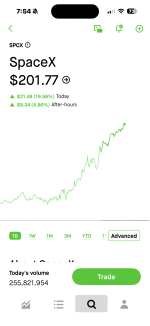
I got allocated in my normal trading account, but not in my Roth. Kinda annoying. I would have FAR preferred the inverse. I almost entirely long term hold, so if I did want to sell with this bump (I never participat in IPOs so the 6mo threat is meaningless to me) it would have been way less complicated.

Oh well. May still place a sell order if it reaches above 30-35%… and then just buy back in in a couple months when it definitely will dip back down
 
1781306351584.png
 
NVIDIA (NVDA) just did something a company growing revenue 85% a year almost never does. Alongside its May 20 earnings, the board raised the quarterly dividend from $0.01 to $0.25 a share, a 25-fold increase, and authorized an additional $80 billion in share repurchases with no expiration date, according to NVIDIA’s investor relations materials.
Still a great LTH imo
 

They engineered this very well if this cursor deal is at today’s share price. lol. And cursor made a mistake if they didn’t lock the deal in at the ipo price.

You go super low float with lockups, you have Nasdaq100 entry in 15 days, you obviously expect a pop after IPO, and due to retail interest because of Musk factor that builds the hype around the stock, which they then use at a their way to buy Cursor at a significantly better value. Sure $60b is $60b but it’s a stock deal, and they went from doing an employee liquidity even at ~$800B literally just 6 months ago in December. Today they were valued at $2.66 trillion lmao

All that to say this is a major opportunity for SpaceX to acquire MORE! Buy a Telecom and acquire more spectrum… or the turned Tesla acquisition I guess….
 
Last edited:


Trying to draw generalizable conclusions from the SpaceX IPO may appear a fool’s errand. The company and founder seem sui generis. Its business mix, (interplanetary) ambitions, and governance and control structure all defy conventional benchmarking. But don’t treat this as a one-off. The timing of the IPO (arriving 22 years after the company’s founding), cumulative value that’s accrued to private investors, and stock price impact of index inclusion are all emblematic of a broader structural shift.

The rise of private markets…

In a prior era, SpaceX would have likely made its market debut as a midcap growth stock. But such assets have gravitated to private portfolios over the past two decades. As private markets have scaled, companies no longer have to go public to secure capital for growth or liquidity. And when their existing sponsors need to exit, new private investors can step in to guide them through the next stage of their lifecycle.

Since 2000, the number of US public companies has halved due to a sharp fall in IPOs relative to delistings. The number of IPO candidates[1] increased 2.6x over that time, but “listing propensity” – the probability that a given company will elect to go public after exceeding certain size thresholds – dropped by 62%. Private capital now earns twice as much of the lifetime returns of businesses that do eventually go public (Figure 1). (You’d have to believe that SPCX’s market cap will exceed 20% of 2036 US GDP for it to buck this trend.)


Figure 1: Delayed IPOs double private market’s share of total value


​

​

Trying to draw generalizable conclusions from the SpaceX IPO may appear a fool’s errand. The company and founder seem sui generis. Its business mix, (interplanetary) ambitions, and governance and control structure all defy conventional benchmarking. But don’t treat this as a one-off. The timing of the IPO (arriving 22 years after the company’s founding), cumulative value that’s accrued to private investors, and stock price impact of index inclusion are all emblematic of a broader structural shift.

The rise of private markets…

In a prior era, SpaceX would have likely made its market debut as a midcap growth stock. But such assets have gravitated to private portfolios over the past two decades. As private markets have scaled, companies no longer have to go public to secure capital for growth or liquidity. And when their existing sponsors need to exit, new private investors can step in to guide them through the next stage of their lifecycle.

Since 2000, the number of US public companies has halved due to a sharp fall in IPOs relative to delistings. The number of IPO candidates[1] increased 2.6x over that time, but “listing propensity” – the probability that a given company will elect to go public after exceeding certain size thresholds – dropped by 62%. Private capital now earns twice as much of the lifetime returns of businesses that do eventually go public (Figure 1). (You’d have to believe that SPCX’s market cap will exceed 20% of 2036 US GDP for it to buck this trend.)


​

​

Figure 1: Delayed IPOs double private market’s share of total value


​


Did you buy any at IPO
 
Back
Top