- Joined
- Nov 5, 2011
- Messages
- 41,208
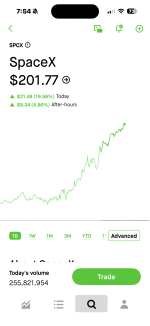
Read up 25% already

Maybe a month or 3. They get early entry into top100 in 15days, insiders can start selling and as the price stays certain % higher their lockups end early, bigger insiders lockup ends 180days, musks doesn’t end for 1yr…Ummm. Maybe we know the price by Monday?
So did any of yall participate? I got allocated 10 shares
I got allocated in my normal trading account, but not in my Roth. Kinda annoying. I would have FAR preferred the inverse. I almost entirely long term hold, so if I did want to sell with this bump (I never participat in IPOs so the 6mo threat is meaningless to me) it would have been way less complicated.No. Decided to stay away.


Thanks!!! Options start tomorrow. Gonna be very volatile and cray cray.I’ll be the sacrificial lamb and not buy on Friday for you guys to profit
|
|
Trying to draw generalizable conclusions from the SpaceX IPO may appear a fool’s errand. The company and founder seem sui generis. Its business mix, (interplanetary) ambitions, and governance and control structure all defy conventional benchmarking. But don’t treat this as a one-off. The timing of the IPO (arriving 22 years after the company’s founding), cumulative value that’s accrued to private investors, and stock price impact of index inclusion are all emblematic of a broader structural shift.
The rise of private markets…
In a prior era, SpaceX would have likely made its market debut as a midcap growth stock. But such assets have gravitated to private portfolios over the past two decades. As private markets have scaled, companies no longer have to go public to secure capital for growth or liquidity. And when their existing sponsors need to exit, new private investors can step in to guide them through the next stage of their lifecycle.
Since 2000, the number of US public companies has halved due to a sharp fall in IPOs relative to delistings. The number of IPO candidates[1] increased 2.6x over that time, but “listing propensity” – the probability that a given company will elect to go public after exceeding certain size thresholds – dropped by 62%. Private capital now earns twice as much of the lifetime returns of businesses that do eventually go public (Figure 1). (You’d have to believe that SPCX’s market cap will exceed 20% of 2036 US GDP for it to buck this trend.)
Figure 1: Delayed IPOs double private market’s share of total value